Funboard: The Ultimate Beginner-Intermediate Surfboard
Discover why the funboard, often called a mini mal, is the ideal choice for progressing surfers. This versatile shape bridges the gap between longboards and shortboards, offering stability, paddle power, and maneuverability. Learn how a funboard can accelerate your surfing journey and provide endless fun in various conditions.
Surfboard Life · February 11, 2026 · 13 min read
Funboard: The Ultimate Beginner-Intermediate Surfboard
A funboard, often referred to interchangeably as a mini mal (short for mini-Malibu), is an excellent choice for surfers transitioning from absolute beginners to more confident riders. This versatile board type offers an optimal blend of stability, paddle power, and maneuverability, making it the perfect beginner intermediate board to accelerate skill progression and maximize wave count. With its generous volume and user-friendly design, the funboard allows surfers to catch more waves, practice fundamental turns, and enjoy longer rides, truly enhancing the fun aspect of surfing.
What is a Funboard? Unpacking the Mini Mal Design
A funboard sits comfortably in the surfboard spectrum, slotting in between the stability of a traditional longboard and the performance-oriented characteristics of a shortboard. Typically ranging from 6'6" to 8'6" in length, with widths between 21 to 23 inches and thicknesses from 2.5 to 3.25 inches, these boards are designed for ease of use. The term mini mal accurately describes its lineage, as it often shares the rounded nose, flatter rocker, and ample width of a classic Malibu longboard, just in a more compact package.
Experienced shapers understand that the key to a great funboard lies in its balanced design. It usually features a medium to low rocker for efficient paddling and wave catching, combined with a relatively full outline that provides stability. The tail designs vary, from rounded pin to squash, influencing its turning characteristics. This thoughtful construction delivers a high wave count, which is crucial for skill development. More waves caught directly translate to more practice time, making the mini mal an invaluable tool for improving your surfing technique.
According to a 2025 global survey by Surfline Research, intermediate surfers who consistently rode boards with higher practical volume in their learning phase reported a 30% faster progression in their wave count and turn execution compared to those who rushed to shorter boards. This data underscores the importance of a forgiving platform like the funboard. For an in-depth look at how different board shapes influence your ride, explore our Board Types Guide.
Pro Tip (2026 Update): Don't be afraid of volume! Many intermediate surfers make the mistake of going too short too soon. Embrace the extra foam of a funboard – it's your friend in the lineup, making paddling easier and catching waves more efficient. Modern funboard designs are also incorporating subtle performance elements, like refined rail profiles and bottom contours, that allow for greater maneuverability without sacrificing stability, making the volume even more effective. Shapers are increasingly focusing on "performance volume distribution," placing foam where it's needed most for paddle power and stability, while subtly thinning rails for better engagement with the wave.
Why a Funboard is the Ultimate Beginner Intermediate Board
The funboard excels as a beginner intermediate board for several compelling reasons, primarily its ability to foster rapid skill progression without sacrificing enjoyment. Its inherent stability makes popping up easier and maintaining balance on the wave a less daunting task. This reduces frustration and keeps stoke levels high, which is paramount for continued learning in surfing.
One of the funboard's greatest advantages is its superior paddle power. The increased length and volume, when compared to a shortboard, allow surfers to paddle into waves earlier and with less effort. This means you’ll catch more waves, even on smaller, weaker days. More waves caught equals more opportunities to practice your pop-up, trim, and initial turns. This is a game-changer for those looking to advance beyond the white water and start riding unbroken waves.
Furthermore, the funboard offers a manageable level of maneuverability. While not as responsive as a high-performance shortboard, it allows for controlled turns and directional changes. This is the perfect training ground for developing the fundamental body mechanics of carving, bottom turns, and cutbacks. It bridges the gap between simply riding straight to actively manipulating the board on the wave face. For personalized board recommendations based on your skill level, try our Board Finder Quiz.
Sizing Your Funboard: Finding the Sweet Spot
Choosing the correct size for your funboard is crucial for maximizing its benefits. While general guidelines exist, individual factors like surfer weight, height, skill level, and local wave conditions play a significant role. As a general rule, a funboard should be significantly longer and wider than your height, providing ample volume.
For a beginner intermediate board, aim for a length roughly 1 to 2 feet taller than you, with widths in the 21-22.5 inch range and thicknesses between 2.75-3.1 inches. However, the most critical metric for any surfboard, especially a funboard, is volume. This is measured in liters and directly correlates with paddle power and stability. A good starting point for an intermediate surfer on a funboard is a volume-to-weight ratio that places them comfortably in the 'stable' or 'performance stable' range.
- Beginner-Intermediate (learning to turn): 0.45 – 0.55 Liters per kg of body weight.
- Intermediate (consistent turns): 0.40 – 0.45 Liters per kg of body weight.
- Progressive Funboard (2026 Update): Some shapers are now offering funboards with slightly lower volume (0.38-0.42 L/kg) but refined bottom contours and rail shapes that allow experienced riders to push their performance without sacrificing too much paddle power. This caters to intermediate surfers looking to transition more aggressively or advanced surfers seeking a fun, flowing board for smaller conditions. These designs often feature subtle concaves, vee through the tail, and performance-oriented rail bands.
For example, a 75kg (165 lbs) intermediate surfer might look for a board with 30-41 Liters of volume. Using our Volume Calculator can help you pinpoint the ideal volume for your specific needs, taking the guesswork out of sizing your next funboard. Remember, more volume typically means easier paddling and wave catching, which accelerates learning.
Fin Setups for Your Funboard
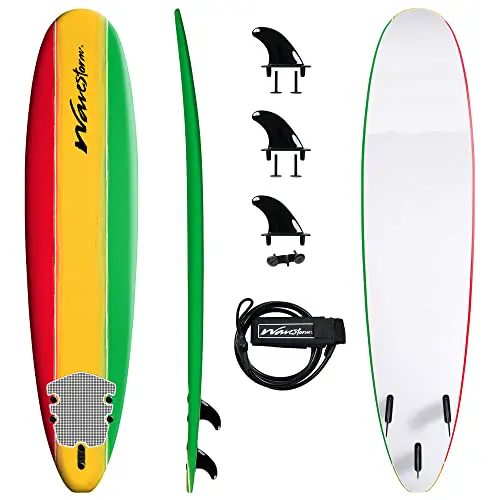
The fin setup significantly impacts how your funboard performs, affecting speed, drive, and maneuverability. Most funboards, or mini mals, come with a thruster (3-fin) or 2+1 (single fin with two smaller side bites) setup, with some offering quad (4-fin) or even 5-fin convertible options.
- Thruster (3-fin): This is the most common and versatile setup for a funboard. It offers a good balance of drive, control, and maneuverability, making it suitable for a wide range of conditions and skill levels. Two side fins and one center fin work in harmony to provide stability and allow for smooth turns. This is an excellent choice for a beginner intermediate board as it's predictable and forgiving.
- 2+1 Setup: This consists of a larger center fin and two smaller side fins (side bites). This configuration provides the deep, flowing turns characteristic of a single fin, combined with the added stability and drive from the side bites. It's often preferred for a more classic, drawn-out surfing style, and can be particularly fun in longer, mellow waves. Some surfers experiment with different size center fins to dial in their feel. This setup has seen a resurgence in popularity for its blend of traditional feel and modern performance.
- Quad (4-fin): Less common on traditional funboard shapes, but some modern designs increasingly offer this. A quad setup typically provides more speed and a looser, more skate-like feel. It's great for generating speed in weaker waves and can be lively underfoot, potentially suited for the more advanced funboard rider looking for a different sensation or those wanting to maximize speed in less powerful surf.
- 5-Fin Convertible (2026 Update): A growing trend in funboard design is the inclusion of a 5-fin box setup. This allows surfers to experiment with thruster, quad, or even twin-fin (on specific funboard shapes with flatter rocker) configurations, offering unprecedented versatility depending on wave conditions and personal preference. This is ideal for a surfer who wants to truly dial in their ride and explore different feels without needing multiple boards.
Understanding fin templates and materials can further refine your ride. For a comprehensive guide on fin systems and how they influence performance, check out our Fin Systems Guide. Learning how to swap fins and experiment can unlock different performance characteristics from the same board.
Mastering the Funboard: Techniques for Intermediate Surfers
The funboard is an incredible platform for honing essential surfing techniques. Its stability and paddle power allow you to focus on the nuances of wave riding rather than struggling to catch waves or stay upright. Here are key techniques to master on your mini mal:
- Consistent Pop-Up (with Head-Up Technique): With the extra stability, practice a fluid and efficient pop-up every time. Aim for one swift motion, landing with your feet centered and shoulders parallel to the stringer. New for 2026: Focus on keeping your head up and eyes looking down the line before your feet land. This advanced pop-up technique helps with immediate directional control and vision, drastically improving your chances of making the wave and setting up your first turn. Repetition is key here, and the funboard provides ample opportunity.
- Trimming and Weight Distribution: Learn to shift your weight slightly forward or backward (nose to tail) to adjust your speed and stay in the pocket of the wave. A slight forward lean accelerates, while shifting back slows you down. This subtle control is fundamental to longer rides and connects directly to timing your maneuvers.
- Bottom Turns (Refined Execution): This is arguably the most crucial maneuver. Approaching the bottom of the wave, compress your body, then drive up the wave face, using your core and leading arm to initiate the turn. On a funboard, you’ll have more time to set up and execute a smooth, controlled bottom turn, providing the foundation for all subsequent maneuvers. 2026 Tip: Focus on looking where you want to go throughout the turn – your body will naturally follow. Emphasize a powerful, extended compression to projection, setting up maximum speed for your next move.
- Top Turns/Cutbacks (Expanding Repertoire): Once you've mastered the bottom turn, you can begin to guide the board back towards the peak of the wave. A cutback allows you to re-engage with the power source. On a funboard, these turns will be more arcing and flowing, rather than sharp and pivotal like on a shortboard. This develops a beautiful, classic style. Emerging Technique: As your skills grow, try adding a small "re-entry" or "foam climb" at the end of your top turn on a funboard to simulate shortboard maneuvers with its forgiving platform. This teaches board control in the critical part of the wave without the intensity of a high-performance board.
- Wave Selection and Positioning (Advanced Reads): The funboard's paddle power makes you less reliant on perfect wave timing. Use this advantage to identify waves with clear, unbroken faces that will allow you to practice your maneuvers from start to finish. Good wave selection is a skill that translates to any board type. 2026 Focus: Pay attention to swell direction and incoming sets to anticipate where the best waves will break, using your funboard's paddle power to get into optimal position earlier than others. Understanding peak formation and section speed will elevate your wave catching and riding efficiency.
Developing these skills on a funboard builds a strong foundation that will seamlessly transfer to shorter, more performance-oriented boards as your abilities advance. For detailed instruction on basic to advanced techniques, visit our Learn to Surf section.
The Funboard Lifestyle: More Than Just a Board
The funboard represents a particular ethos within surfing – one that prioritizes enjoyment, wave count, and a relaxed approach over radical maneuvers and competitive aggression. It’s about being in the water, connecting with the ocean, and simply having a good time. This makes the mini mal incredibly popular among a diverse range of surfers, from those easing into the sport to experienced riders looking for a mellower session.
Many pro surfers and advanced riders keep a funboard in their quiver specifically for smaller, weaker days or just for unwinding and enjoying the glide. As Jamie O'Brien (JOB), known for his fearless Pipeline antics, once said in a recent interview with Stab Magazine, "Sometimes you just want to go out and surf with no pressure, just cruise on something with a bit more glide." This sentiment perfectly captures the spirit of the funboard. It's a board that reminds us that surfing, at its core, is about fun.
Its forgiving nature also makes it an excellent choice for traveling, as it can handle a wider variety of wave conditions that you might encounter. From knee-high mush to head-high peeling walls, a well-chosen funboard can adapt, making your surf trips more consistently enjoyable. The durability of modern funboards, often constructed with epoxy and even new composite materials like carbon-stringer reinforced EPS (as seen in some 2025-2026 models), also means less time in the Repair Center and more time in the water.
Funboard vs. Longboard vs. Shortboard: A Quick Comparison
To fully appreciate the role of the funboard, it's helpful to compare it to its neighbors on the surfboard spectrum. This overview highlights why the mini mal is truly in a class of its own for progression.
| Feature | Longboard (9'+) | Funboard (6'6"-8'6") | Shortboard (5'-6'6") | | :------------------ | :------------------------- | :-------------------------- | :----------------------- | | Paddle Power | Excellent | Very Good | Moderate | | Stability | Highest | High | Lowest | | Maneuverability | Lowest (drawn-out turns) | Moderate (controlled turns) | Highest (radical snaps) | | Wave Catching | Easiest (can catch anything)| Easy (great for unbroken waves) | Harder (needs steep waves)| | Ideal Skill Level| Beginner, Classic Rider | Beginner Intermediate Board, Cruise | Intermediate to Advanced | | Typical Wave Size| Very Small to Overhead | Small to Head-High | Medium to Double Overhead|
This table clearly illustrates how the funboard provides a unique balance, offering enough stability and paddle power to make surfing enjoyable and progressive, without being as cumbersome as a full-sized longboard, or as challenging as a shortboard. It’s the Goldilocks board, just right for finding your rhythm in the waves.
Caring for Your Funboard: Maintenance Tips
Proper care will extend the life of your funboard and keep it performing optimally. Here are some essential maintenance tips:
- Rinse After Use: Always rinse your board with fresh water after each session to remove salt, sand, and dirt. This prevents wax buildup grim and can slow down wear on components like fin boxes.
- Avoid Direct Sunlight & Heat: Prolonged exposure to direct sunlight and excessive heat (even inside a car) can delaminate your board over time, causing bubbles under the fiberglass. Store your board in a cool, shady place or use a ventilated, reflective board bag.
- Waxing: Apply wax appropriate for your water temperature. A thin, even coat is usually best. Scrape off old wax periodically for optimal traction. Consider using eco-friendly wax options that are gaining popularity in 2025-2026, often made from natural ingredients and less harmful to marine ecosystems. Learn about the different parts of your board and how they work in our Surfboard Anatomy guide.
- Dings and Repairs: Inspect your board regularly for dings or cracks. Even small dings can let water in, potentially causing delamination or waterlogging. Get them repaired promptly. Our Repair Center offers great resources for DIY fixes or finding a professional. For quick fixes, new UV-activated resin formulas are faster and more durable than ever, curing in minutes under sunlight.
- Transport Safely: Use a board bag or rack pads when transporting your funboard to prevent dings and strap damage. Secure it properly to your vehicle to avoid accidents. Modern board bags often feature enhanced padding, integrated fin protection, and ventilation for improved protection.
By following these simple steps, your trusty funboard will provide countless hours of surfing enjoyment. Remember, proper care is an investment in your surfing future!
Conclusion: Embrace the Fun with a Funboard
The funboard is undeniably one of the most effective and enjoyable tools for surfing progression. As a superb beginner intermediate board, it strikes the perfect balance between stability and maneuverability, ensuring a high wave count and rapid skill development. Whether you call it a funboard or a mini mal, its design is centered around making surfing accessible, rewarding, and, above all, fun.
From mastering your pop-up to nailing your first smooth cutback, this board type supports every step of your journey towards becoming a more confident and stylish surfer. Don't underestimate the power of a board that simply makes you want to get in the water more often. Embrace the glide, enjoy the ride, and let your funboard be your guide to endless surfing stoke. Ready to find your perfect ride? Head over to our the board finder for personalized recommendations and expert insights.
Frequently Asked Questions About Funboards
Q1: Is a funboard good for beginners?
Absolutely! While an ultra-long longboard might offer even more stability initially, a funboard is an excellent stepping stone for beginners, particularly after they've mastered catching white water waves. Its added volume and stability make it much easier to paddle, catch unbroken waves, and practice standing up compared to shorter boards, truly serving as a fantastic beginner intermediate board. It provides a manageable platform for developing core skills crucial for long-term surfing success.
Q2: What's the difference between a funboard and a mini mal?
There is no significant difference; the terms funboard and mini mal (short for mini-Malibu) are often used interchangeably to describe the same type of board. They represent a category of mid-length surf