New Surfboard Technology 2026: The Ultimate Guide
Discover the latest breakthrough innovations in new surfboard technology 2026. From bio-composite flex profiles and recycled foam blanks to smart telemetry fins and verified shark deterrents, here is your definitive buyer's guide.
Surfboard Life · October 30, 2026 · 13 min read
The new surfboard technology 2026 landscape represents a pivotal leap forward, blending bio-engineered composite laminations, generative flex patterns, and active smart electronics into production blanks. Today's commercial releases prioritize high-tensile organic fibers, closed-loop circular EPS blanks, and hydrodynamically tuned flex channels that dramatically increase drive, spring, and longevity without sacrificing environmental ethics.
For decades, surfboard manufacturing remained tethered to toxic polyurethane (PU) foam blown with ozone-depleting gases and wrapped in polyester resin. While PU offered predictable dampening in choppy water, its catastrophic environmental toll and rapid structural decay left surfers constantly seeking something better. As the surfing world evolved through epoxy revolutions and carbon exoskeletons, the industry finally arrived at an inflection point. Today, the convergence of aerospace engineering, computational fluid dynamics, and green chemistry has elevated board performance to heights unimaginable even a decade ago.
Whether you are hunting for lightning-fast responsiveness in two-foot slop, hunting heavy reef barrels, or reducing your carbon footprint, understanding the technical nuances of modern craftsmanship is vital. In this guide, we break down commercial breakthroughs, debunk marketing gimmicks, and deliver an unfiltered performance showdown to help you choose your next sled.
Surfboard Materials Comparison: Traditional PU vs. Modern Composites
To make an informed purchase, you must understand how structural materials interact in salt water under variable wave loading. A clear surfboard materials comparison reveals why legacy constructions are rapidly losing market share to advanced bio-composites and multi-density hybrid cores.
Conventional polyurethane (PU) cores glassed with polyester (PE) resin remain popular among traditionalists for their damp, shock-absorbing feel in heavy chop. However, PU cores suffer from rapid cell compression, leading to early deck heel dents, yellowing from UV radiation, and snap vulnerability. Modern expanded polystyrene (EPS) paired with bio-epoxy delivers a lighter blank with roughly 30% greater tensile strength and superior energy rebound out of turns.
Taking this evolution further, 2026 introduces composite sandwich constructions that integrate basalt fibers, aerospace-grade flax cloth, and recycled PET matrix layers. These materials offer progressive torsional flex, meaning the board twists along its rail line through critical maneuvers, then snaps back instantaneously to propel you out of turns.
| Construction Type | Average Weight (6'0" Shortboard) | Flex Rebound Speed | Durability & Ding Resistance | Eco-Footprint Rating | Price Range | Commercial Availability | | :--- | :--- | :--- | :--- | :--- | :--- | :--- | | Standard PU / Polyester | 2.8 - 3.2 kg | Moderate (gradually deteriorates) | Low to Moderate | Poor (Petrochemical based) | $650 - $850 | Immediate / Widespread | | High-Density EPS / Bio-Epoxy | 2.2 - 2.5 kg | Fast / Springy | High | Moderate (Recyclable core) | $800 - $1,050 | Immediate / Widespread | | Flax Composite / Plant Resin | 2.4 - 2.7 kg | Dynamic & Smooth | Very High | Excellent (Certified Eco-Board) | $950 - $1,250 | Readily Available | | Carbon Exoskeleton / Stringerless | 2.1 - 2.4 kg | Ultra-Fast / Rigid snap | High (Brittle rail impacts) | Moderate | $1,100 - $1,450 | Readily Available | | Wood-Hollow / Cork Hybrid | 3.1 - 3.6 kg | Natural vibration dampening | Exceptional | Outstanding (Biodegradable core) | $1,200 - $1,800 | Semi-Custom Orders |
Selecting the right density and flex profile directly influences how much flotation you need. Before investing in cutting-edge composite foam, consult our Volume Calculator to pinpoint your exact displacement requirements based on body weight, fitness, and wave type.
Sustainable Surfboard Technology: Eco-Performance Without Compromise
For years, eco-friendly surfboards suffered from an unfair reputation: surfers assumed that any board built with sustainable materials was either too heavy, sluggish, or fragile for serious shredding. In 2026, sustainable surfboard technology completely dismantles that myth.
Leading manufacturers now work closely with environmental certification boards to deliver Gold Level Eco-Boards that outperform petroleum-based counterparts on the World Surf League Championship Tour. The modern green board relies on three distinct material pillars:
- Upcycled Circular Cores: Instead of pristine virgin petroleum, blanks are shaped from 100% post-consumer expanded polystyrene collected from packaging waste, or mushroom mycelium cores developed in closed fungal molds. These cores possess uniform cellular structure, preventing water intrusion if punctured.
- Naturally Sourced Bio-Resins: High-performance epoxy matrices now replace up to 50% of synthetic petroleum carbons with pine pulp byproducts and bio-derived epichlorohydrin. These resins generate zero volatile organic compounds (VOCs) during glassing while offering higher flexural strength than brittle polyester resins.
- Flax and Basalt Cloth Reinforcements: Woven flax textiles naturally absorb high-frequency road chatter—or surface chop—far better than synthetic fiberglass. When volcanic basalt fibers are cross-woven with flax, the resulting composite skin resists severe heel denting without stiffening the board into an unyielding plank.
As verified by comprehensive sustainability reports in Surfer Magazine, switching to bio-composite blanks lowers a board's cradle-to-grave carbon footprint by up to 45%. Better yet, boards built using sustainable surfboard technology maintain their flex memory significantly longer than conventional boards, sparing boards from prematurely ending up in landfills.
Pro Tip: If you ding a bio-composite board reinforced with flax, never let saltwater sit inside the laminate. Flax is a natural plant fiber that swells when exposed to marine moisture over extended periods; seal rail cracks immediately using our tips in the Repair Center.
The Best Surfboard Construction 2026: Carbon, Flex Patterns, and Durability
When evaluating the best surfboard construction 2026 for performance surfing, the conversation focuses on dynamic torsional flex. A board must bend through its longitudinal axis during a bottom turn to load up energy, while the rails twist slightly to match the wave face's transition curves.
Traditional wood stringers provide baseline stiffness, but they offer unidirectional, static flex that weakens over time. In contrast, 2026 stringerless EPS designs leverage generative carbon-tape vector matrices. Shapers use computer-modeled stress algorithms to place unidirectional carbon fibers along precise load lines. The center of the deck remains flexible for easy paddling and soft landings, while the tail rails load up immense kinetic energy that releases like a slingshot as you pivot off the lip.
[Dynamic Kinetic Flex Distribution]
Nose: Low Inertia (Lighter swing weight)
  ↓
Midsection: Controlled Longitudinal Flex (Paddle comfort + wave entry)
  ↓
Tail/Fins: High Torsional Stiffness (Slingshot kinetic drive out of turns)
Another breakthrough in the best surfboard construction 2026 category is the dual-density EPS blank. These cores utilize low-density, featherweight foam along the center stringer line to keep swing weight at an absolute minimum, flanked by high-density parabolic rails. This configuration shields the most vulnerable perimeter of your board from catastrophic fractures during heavy shorebreak wipeouts.
To discover how modern rail construction and deck contours impact your specific maneuverability, check out our deep dive on Surfboard Anatomy.
Smart Surfboard Fins Shark Deterrent and Sensor Tech: Fact vs. Fiction
Few categories in modern surf equipment generate as much curiosity—and skepticism—as active electronics and marine safety hardware. The emergence of smart surfboard fins shark deterrent hardware has moved high-tech accessories out of academic labs and into surf lineups.
The Science of Active Shark Deterrence
Commercial systems in 2026 combine two primary deterrent mechanisms:
- Electromagnetic Field Generators: Sharks and rays possess highly sensitive electro-receptors known as the Ampullae of Lorenzini, used to locate prey in murky water. Specialized sub-surface transmitters embedded inside surfboard fins and tail pads project an localized three-dimensional electrical gradient. Peer-reviewed marine studies highlighted across Surfline demonstrate that strong, pulsed electromagnetic fields induce temporary spasms in shark sensory pores, effectively causing them to veer away without inflicting lasting injury.
- Permanent Neodymium Magnetic Arrays: Built directly into fin bases, high-flux magnetic fields saturate near-field sensory receptors. While less powerful than active electrical pulses, passive magnetic systems require zero batteries and function indefinitely.
While independent testing confirms a measurable reduction in curiosity-driven approaches from juvenile white sharks and bull sharks, shapers and marine scientists emphasize that no electronic system guarantees 100% protection in predatory feeding zones. Treat deterrent systems as an extra layer of insurance, not an invincibility shield.
Telemetry-Equipped Smart Fins
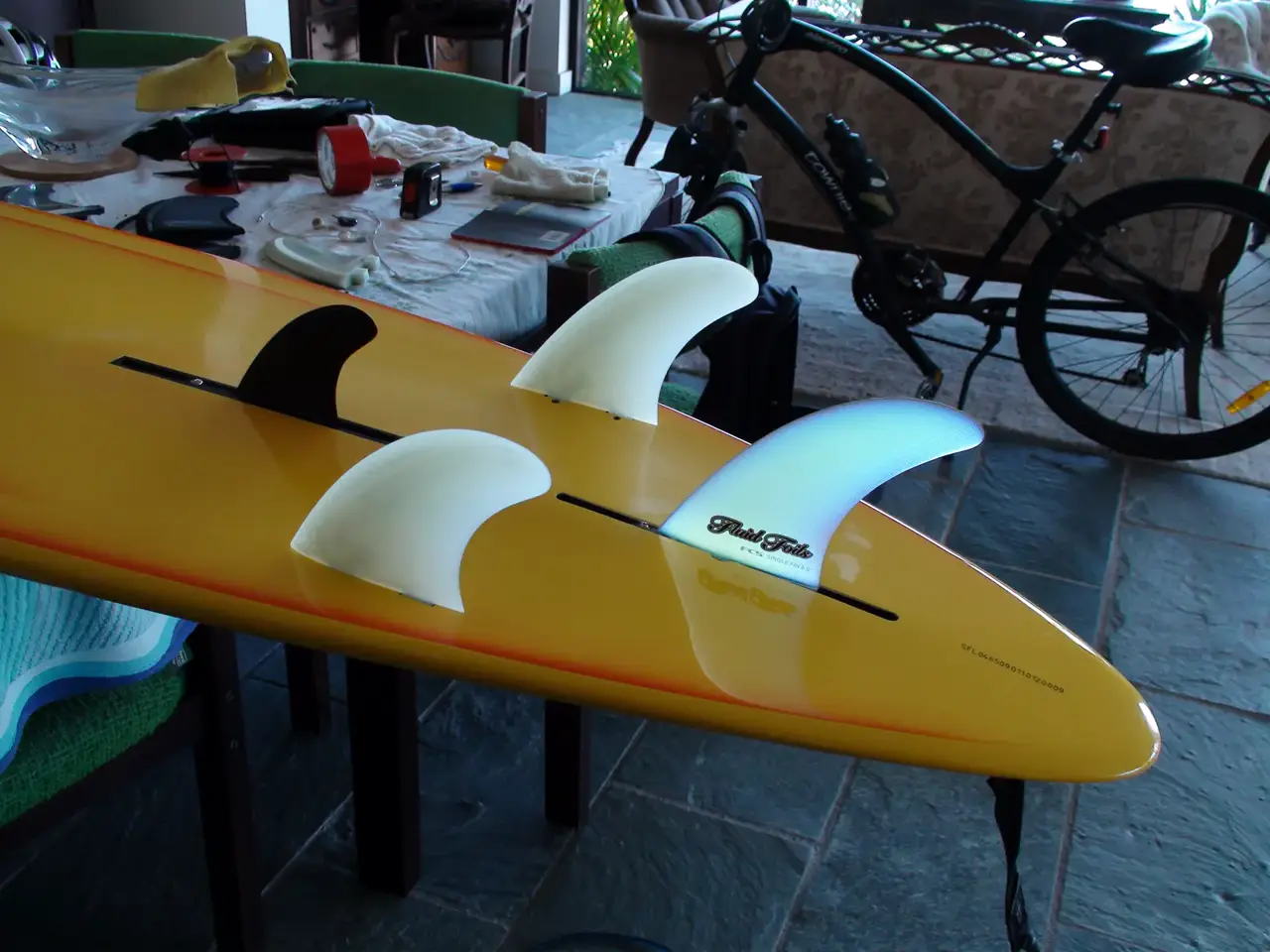
Alongside safety technology, 2026 has witnessed the commercial rise of telemetry-equipped fins. These units house microscopic, waterproof MEMS accelerometers, pressure transducers, and micro-gyroscopes right inside the fin foil. As covered in our Fin Systems Guide, fin hydrodynamics dictate drive and pivot; smart fins capture real-time metrics including:
- Top speed across the wave face (accurate to 0.1 knots)
- G-force exertion through the apex of bottom turns
- True rail lean angle and carve duration
- Paddle-to-wave transition efficiency
Surfers can sync their fins to a smartphone or smartwatch immediately after peeling off their wetsuit, converting raw session sensations into hard data.
Pro Tip: Smart fins require careful preventative care. Salt crystallization around wireless charging contacts leads to rapid corrosion; always rinse electronic fin boxes and magnetic bases thoroughly with lukewarm fresh water after every single session.
Commercial Realities: New Surfboard Technology 2026 You Can Buy Today
With trade shows constantly teasing experimental concepts, it can be hard to tell what is actually available in local surf shops from vaporware prototypes. Below is an honest appraisal of what technologies you can purchase off the rack right now versus concepts that need more time in the lab.
+-------------------------------------------------------------+
|          2026 TECH AVAILABILITY & MATURITY SPECTRUM         |
+-------------------------------------------------------------+
[COMMERCIALLY AVAILABLE]      [EMERGING / NICHE]      [PROTOTYPE / LAB]
• Recycled EPS Blanks         • Integrated E-Boost    • Mycelium-Grown
• Bio-Epoxy Resins            • Integrated Solar Mats   Custom Blanks
• Carbon Vector Bands         • Telemetry Smart Fins  • Self-Healing Liquid
• Magnetic Shark Fins         • Active Foil Wings       Resin Membranes
+-------------------------------------------------------------+
Commercially Available Now
- Plant-Derived Bio-Resins & Upcycled EPS: Found across nearly every major shaper's catalog today. Standard pricing runs $100 to $180 above base PU construction, and structural performance is exceptional.
- Carbon Flex Rails and Tension Bands: Proven across thousands of competitive heats, stringerless carbon builds are available from mass-market labels worldwide.
- Passive Magnetic & Visual Shark Deterrent Systems: Available as aftermarket fin boxes, custom fin pairs, and base decals with zero modifications needed to your existing board.
Emerging and Niche (Accessible but Costly)
- Micro-Jet Integrated Paddle Assist: Compact, battery-driven electric jet motors mounted into center fin boxes provide 15–20 pounds of thrust. While legal in open ocean conditions, their $1,200+ price tag, added weight (1.8 to 2.5 kg), and lineup etiquette controversies relegate them primarily to open ocean cruisers, adaptive athletes, and big-wave sweepers.
- Telemetry Smart Fins: Available from boutique sensor brands; prices range from $350 to $600 per fin set, appealing largely to data-obsessed competitive surfers and surf coaches.
Experimental Prototypes (Not Ready for Broad Consumer Use)
- Self-Healing Nanotech Resins: Polymer coatings containing micro-capsules of liquid resin designed to rupture and fill dings on contact with UV light remain confined to university testing environments.
If you are overwhelmed by the choices and unsure which setup fits your local break, take our interactive Board Finder Quiz or consult our the board finder for personalized gear advice.
Buyer’s Decision Matrix: Matching 2026 Tech to Your Skill Level
Investing in cutting-edge materials only pays off if the board's flex characteristics and mechanical feedback match your current stage of progression. Below is our actionable buyer's guide for matching new surfboard technology 2026 directly to your surfing ability.
Beginner Surfers        → High-Density Soft-Top / Bio-Composite Hybrid Cores
Intermediate Surfers    → Flax-Basalt / EPS Bio-Epoxy (Durable, lively, vibration-dampened)
Advanced / Pro Surfers  → Stringerless EPS with Generative Carbon Vectors (Maximum spring)
Big Wave / Slab Riders  → High-Density Foam Sandwich / Dampened Tri-Axial Basalt Skins
1. Beginners and Novices
- Recommended Technology: Molded closed-cell bio-composite foamies or eco-epoxy hybrid fish designs.
- Why It Works: Beginners need maximum paddling displacement, stability, and extreme ding resistance against shoreline drops and rogue knees. High-tensile carbon stringers are wasted here; prioritize durable EPS cores glassed with heavy bio-resin cloth.
- Explore Further: Discover essential fundamentals and gear setup recommendations inside our dedicated guide to Learn to Surf.
2. Intermediate Surfers
- Recommended Technology: Flax-cloth composite with lightweight bio-epoxy or parabolic rail stringers.
- Why It Works: Intermediates generate basic speed but struggle with surface chatter when waves turn choppy or wind-blown. The organic dampening properties of woven flax smooth out the ride, while the epoxy core offers spring through cutbacks.
- Explore Further: Compare shape outlines and volume distributions in our Board Types Guide.
3. Advanced and Competitive Surfers
- Recommended Technology: Stringerless high-tensile EPS cores with generative carbon-vector tail patches and smart fin telemetry.
- Why It Works: Advanced surfers generate dynamic lift and need instantaneous response out of turns. Dynamic carbon matrices return energy within milliseconds of loading rail pressure. Telemetry sensors validate turn radiuses, helping refine equipment choices across varying surf breaks.
Pro Tip: Remember that stiffer is not always better. An ultra-stiff, full-carbon surfboard feels jittery and skitters out of control in blown-out, bumpy conditions. Save ultra-rigid carbon boards for clean, glassy point breaks, and stick to flax or damp bio-epoxy for everyday beach breaks.
Maintenance, Ding Repair, and Lifecycle for High-Tech Boards
Investing in high-end construction requires updated maintenance routines. Modern materials behave differently under mechanical stress, heat, and solar exposure compared to classic boards from decades past, as chronicled in our overview of Surfing History.
Heat Sensitivity and Delamination Risks
EPS blanks consist of expanded gas beads. When left inside a hot car under direct sunlight, that trapped air expands aggressively, causing catastrophic outer deck delamination. Always choose heat-reflective board bags, and consider boards built with automated gore-tex pressure release valves if you travel frequently through tropical regions.
Repairing Bio-Epoxy and Exotic Composites
- Never Use Polyester Resin: Applying traditional polyester repair resin to an EPS or bio-composite blank melts the core on contact.
- Match Resin Flexibility: Always patch composite boards using clear bio-epoxy formulations. Bio-epoxy bonds cleanly to standard fiberglass, basalt, and flax without leaving hard spots.
- Check Internal Moisture: If you damage a hollow-wood or flax-laminate board, allow the damaged sector to dry in a low-humidity environment for at least 72 hours before sealing the breach.
Final Verdict: Is 2026 Surfboard Tech Worth the Upgrade?
The wave of new surfboard technology 2026 delivers tangible, testable performance upgrades rather than empty marketing hype. By replacing fragile, toxic petroleum mixtures with long-lasting flax-basalt composites and circular upcycled cores, modern boards offer crisper flex memory, longer operational lifespans, and reduced environmental footprints.
While motorized paddle-assist systems remain an expensive luxury, advancements in bio-composite structures, dynamic carbon load vectors, and active shark-mitigation hardware represent real leaps forward in safety and wave-riding joy. Choose the construction that complements your skill level, protect your investment through diligent care, and enjoy the future of performance surfing.
Frequently Asked Questions
Which new surfboard technologies are commercially available in 2026 rather than experimental?
Commercially available technologies include upcycled closed-loop EPS blanks, USDA-certified plant-derived bio-resins, flax and basalt reinforcement laminates, stringerless carbon-vector flex rails, and magnetic/electromagnetic shark-deterrent fin systems. Experimental concepts like self-healing resins and pure mycelium custom blanks remain limited to university labs and custom prototyping.
How does sustainable surfboard technology compare with conventional boards in speed and lifespan?
Sustainable boards built with modern bio-epoxies and flax or basalt composites match or exceed the top-end speed of standard PU boards while offering roughly 30% greater ding resistance. Unlike conventional polyurethane foam, which suffers progressive cell breakdown and loses flex within 6 to 12 months of hard surfing, bio-composite boards retain their snappy flex memory for multiple seasons.
Do smart surfboard fins with shark-deterrent systems actually work?
Yes, scientific testing demonstrates that pulsed electromagnetic fields and high-flux magnetic fin systems measurably deter curious or investigative passes by predatory sharks by overwhelming their sensitive Ampullae of Lorenzini. However, marine scientists emphasize that no system guarantees 100% protection against territorial charges or ambush strikes in zero-visibility conditions.
What technology is best for everyday, small-wave beach breaks?
For small, weak surf, high-density stringerless EPS paired with carbon-wrapped rails and bio-epoxy resin is unbeatable. EPS cores provide superior buoyancy and sit higher in the water column, cutting surface drag while offering lively flex that converts weak wave energy into forward drive.
How much do advanced 2026 constructions add to the purchase price?
Eco-composite constructions (such as flax cloth with plant-based bio-resins) typically add between $100 and $250 to standard retail board prices, landing between $850 and $1,250. Smart telemetry fins and electronic shark-deterrence systems are sold separately as high-end hardware, generally ranging between $250 and $600 per set.