How to Choose Your First Surfboard: Complete Beginner's Guide
Everything you need to know about picking the perfect beginner surfboard. From soft-tops to foam boards, we break down exactly what to look for.
Surfboard Life · January 18, 2026 · 6 min read
How to Choose Your First Surfboard
Choosing your first surfboard is the single most important decision of your early surfing journey. The right board acts as a launchpad for rapid learning, while the wrong board will leave you exhausted, frustrated, and struggling to catch waves.
Whether you are heading out for your very first session or preparing to purchase your own setup after a handful of lessons, this guide breaks down everything you need to know to choose the perfect beginner surfboard in 2026.
Why Your First Board Matters More Than You Think
The most common mistake novice surfers make is buying a board that is too small, too thin, or too advanced. It is easy to see why: performance shortboards look sleek, fit easily into cars, and match what professionals ride.
However, the golden rule of surfing holds true: You cannot learn to surf if you cannot catch waves.
A board built specifically for beginners prioritizes three core pillars:
- Paddling efficiency: Catching waves before they break.
- Stability: Giving you a forgiving platform to execute your pop-up.
- Safety: Protecting you and others in crowded lineups while you build board control.
Starting on a high-volume, beginner-specific board lets you catch 20 to 30 waves per session instead of struggling for two or three. That wave count is where skill acquisition actually happens.
The Essential Characteristics of a Great Beginner Surfboard
1. Size and Volume: Embrace Generosity
When learning, more volume and length mean more buoyancy, higher paddle speed, and smoother glide into unbroken green waves.
- Length (8'0" – 9'2"): An 8-foot board is the baseline for average-sized adults. If you are taller, heavier (over 85 kg / 185 lbs), or surfing soft, rolling breaks, opt for an 8'6" to 9'2" board. The extra waterline provides early glide and trims effortlessly.
- Width (22" – 24"): Width provides lateral stability. A board narrower than 22 inches will feel tippy and roll beneath you during the pop-up. A generous 22.5" to 23.5" outline keeps the board steady as you transition from your chest to your feet.
- Volume (65 – 90+ Liters): Volume is the volume of water displaced by your board, measured in liters. For true beginners, a solid rule of thumb is a 1.0 to 1.2+ liter-to-weight ratio (e.g., an 80 kg surfer should ideally target 80–90+ liters). When in doubt, always choose the option with more volume.
2. Construction: The Modern Soft-Top Revolution
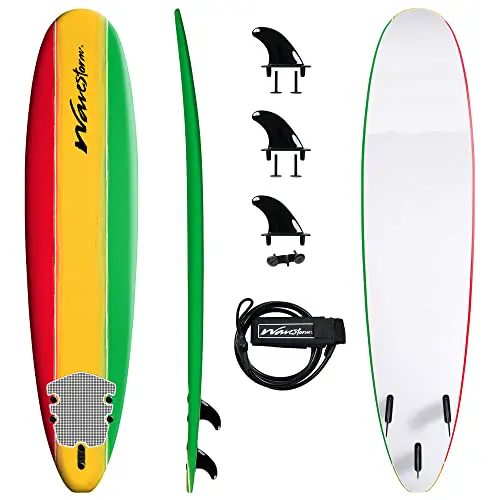
Soft-top (foam) surfboards remain the gold standard for beginners. Gone are the days when foamies were just clunky rental toys. Recent design innovations have transformed modern soft-tops into high-performing, durable, and eco-friendly boards.
Key advantages include:
- Safety First: The resilient foam deck and flexible, rubberized safety fins dramatically reduce the risk of injury during inevitable collisions and wipeouts.
- Durability: Quality soft-tops withstand shorebreak impacts, parking-lot drops, and transport dings that would crack traditional fiberglass boards.
- Modern Hybrid Construction: Leading boards now use multi-stringer setups (dual or triple wooden/composite rods) and fiberglass-reinforced sub-layers under the EVA foam. This prevents the "noodle flex" of cheap boards, giving you the stiffness and glide of a hardboard with the safety of foam.
- Eco-Conscious Builds: Modern brands increasingly utilize recyclable EPS/molded cores, bio-based epoxy resins, and circular manufacturing processes that allow old foamies to be recycled rather than discarded into landfills.
- Wax-Free Textured Decks: Integrated micro-textures and embossed decks are now standard across top-tier soft-tops, eliminating the need for traditional wax and preventing skin abrasion.
3. Outline and Shape: Built for Stability
Look for a shape engineered to eliminate drag and forgive foot placement errors:
- Full, Rounded Nose: Maximizes planing surface at the front, delivering effortless paddle power while preventing the nose from pearling (diving underwater) on takeoff.
- Flat Rocker Profile: A relatively flat bottom curve from nose to tail creates maximum contact with the water, maximizing speed and trim on small, crumbly waves. Top beginner shapes incorporate just a touch of subtle late nose rocker to forgive late drops.
- Boxy, Forgiving Rails: Thick, buoyant edges provide stability through chop and keep the board from catching an edge prematurely.
- Wide Squash or Square Tail: Wide tails capture the push of weak whitewater and rolling swells, providing lift and support as you push up into a standing stance.
4 Common Beginner Mistakes to Avoid
- Downsizing Too Fast: Moving to a 6'6" mid-length or shortboard before you can reliably catch unbroken waves, set your line, and trim both frontside and backside will stall your progress for months.
- Buying Ultra-Cheap "Toy" Foamies: Not all foam boards are created equal. Flimsy, stringer-less foamies purchased from discount department stores bend under paddling weight, buckle in moderate surf, and lack the rigidity required to generate momentum.
- Skipping Fin Safety: Many beginners swap straight to rigid fiberglass fins. Stick with semi-rigid or flexible safety-edge fins while learning the basics of lineup navigation and board recovery.
- Neglecting Pre-Purchase Inspection on Used Boards: If buying a used fiberglass board, check for heavy waterlogging (indicated by uneven weight or yellowed brown patches), stress cracks along the stringer, and loose fin boxes. If choosing a used soft-top, make sure the deck skin is not peeling (delaminating) and the core has not absorbed water.
The Recommended Surfboard Progression Path
Progressing through the right boards at the right times guarantees continuous fun and steady improvement:
[Phase 1: 8'0"–9'0" Soft-Top]
         │
         ▼ (3 to 6+ months; consistent pop-ups & wave trim)
[Phase 2: 7'6"–8'0" Funboard / Hard Mini-Mal]
         │
         ▼ (Angled takeoffs, generating speed, basic cutbacks)
[Phase 3: 6'8"–7'2" Mid-Length / Egg / Fish]
Stage 1: The Foundation (Months 1–6+)
- The Board: 8'0" – 9'0" Quality Soft-Top (70–90L+).
- The Goal: Master paddling technique, understand wave positioning, execute smooth pop-ups, and ride whitewash and unbroken green waves straight and on an angle.
Stage 2: The Transition (Months 6–12+)
- The Board: 7'6" – 8'2" Funboard, Mini-Malibu, or performance hybrid soft-top (55–68L).
- The Goal: Learn to generate speed, perform clean bottom turns, angle your takeoffs, and trim down the open face of the wave with tighter control.
Stage 3: Exploring Diverse Shapes (Year 1+)
- The Board: 6'8" – 7'4" Mid-length, Egg, or modern displacement hull.
- The Goal: Refine positioning, execute directional changes, and explore varied surfboard designs. Check out our comprehensive guide on Types of Surfboards to see which design aligns with the style of surfing you want to pursue.
Dial In Your Sizing with Data
Your ideal board volume depends on your weight, physical fitness, wave conditions, and frequency in the water. Rather than guessing, get a customized calculation tailored to your build:
- Calculate your optimal liter range using our Volume Calculator.
- Match board dimensions to your local wave conditions using the Board Finder.
Final Thoughts
Surfing is one of the most rewarding sports on the planet, but it comes with a steep learning curve. The surfers having the most fun in the water are not the ones riding the smallest boards—they are the ones catching the most waves.
Give yourself every advantage: start on an 8' to 9' soft-top with plenty of volume, focus on consistent technique, and let the wave count drive your progression.
Last updated: January 2026