Surfboards for Tropical Waves: The Ultimate Guide
Selecting the right surfboards for tropical waves is crucial for maximizing performance and fun in warm, powerful conditions. This comprehensive guide from Surfboard Life will help you build the perfect tropical destination surfboards quiver, ensuring you're prepared for perfect reef breaks and endless barrels. Get ready to elevate your tropical surfing experience!
Surfboard Life · April 28, 2026 · 11 min read
Surfboards for Tropical Waves: The Ultimate Guide to Your Tropical Quiver
For pristine reef breaks, powerful barrels, and endless blue water, having the right surfboards for tropical waves is absolutely essential. These conditions often demand boards with specific characteristics that differ significantly from your everyday cold-water or beach break stick. Whether you’re planning a strike mission to Indonesia, an extended stay in Hawaii, or a Caribbean escape, understanding these nuances will unlock your best surfing experience.
Optimal surfboards for tropical waves are typically designed for speed, control in powerful hollow waves, and maneuverability over reefs. They often feature more rocker, refined rails, and specific fin setups to handle the unique challenges and rewards of warm-water conditions. Your tropical quiver should be versatile enough to tackle everything from playful reefs to serious barrels.
Unveiling the Characteristics of Tropical Waves & How They Influence Your Board Choice
Tropical waves are a breed apart. They are often characterized by warm water, powerful swell energy traveling across vast oceans, and the frequent presence of coral or volcanic reef breaks. Unlike shifting beach breaks, tropical reefs offer predictable take-off zones and consistent wave shapes, but they also demand precision and consequence for errors. Understanding these elements is fundamental to choosing your warm water surfboards.
The Anatomy of a Tropical Swell
Tropical swells typically travel long distances, gaining power and organization. This results in cleaner, more defined waves with longer periods compared to local windswell. Pro Tip: Longer period swells carry more energy and create steeper, faster-breaking waves. This requires boards that can efficiently generate speed and maintain control in the barrel, making performance shortboards and step-ups ideal surfboards for tropical waves.
Water temperature also plays a subtle but significant role. Warm water is less viscous than cold water, meaning your board experiences slightly less drag. While not a primary factor for board design, it contributes to the overall feel of fast, frictionless surfing. This encourages lighter, more performance-oriented constructions.
Reef Breaks: Precision and Power
Many iconic tropical surf spots are reef break surfboards havens. These waves break over shallow coral or rock formations, creating incredibly consistent and often hollow waves. The downside, of course, is the unforgiving nature of the bottom. This necessitates boards that:
- Generate speed quickly: To make early drops and get into the barrel.
- Maintain control at high speeds: Essential for navigating tubes and performing critical turns in the pocket.
- Are responsive: Allowing for quick adjustments and maneuverability to avoid shallow sections.
- Are durable (ideally): While no board is reef-proof, a well-glassed board offers better protection. For more on board construction, see our Surfboard Anatomy guide.
Volume and Rocker: Key Considerations for Warm Water Surfboards
The optimal board volume for tropical waves can be slightly lower than what you might ride in less powerful waves. The wave's energy provides more lift, allowing experienced surfers to ride boards with less foam. However, don't go too low, as you still need paddle power, especially in crowded lineups or against strong currents. Use our Volume Calculator to fine-tune your ideal volume based on your weight, skill, and fitness.
Rocker is another critical component. A board with more nose rocker helps prevent pearling on steep drops and aids in tighter turns on powerful, hollow waves. Tail rocker contributes to maneuverability. Experienced shapers often incorporate a continuous curve on boards designed for powerful tropical conditions, allowing for smooth transitional surfing through critical sections.
The Essential Tropical Quiver: Boards for Every Condition
Building the perfect tropical quiver means having options for different wave sizes, shapes, and moods. While a one-board trip is possible, a well-thought-out selection of tropical destination surfboards will ensure you're never under or over-gunned.
1. The High-Performance Shortboard: Your Daily Driver
This is the workhorse of any serious tropical quiver. Designed for carving, turns, and barrels in head-high to double-overhead waves, it's your go-to when the waves are pumping. Look for:
- Length: Your standard to slightly longer than standard shortboard.
- Rocker: Moderate to high nose and tail rocker for steep drops and tight turns.
- Outline: A refined, slightly pulled-in nose and tail for control.
- Rails: Medium-to-low rails for speed and precise engagement.
- Tail Shape: Squash or round-tail (squash for versatility, round for hold in steep waves).
- Fin Setup: Thruster (3 fins) for all-around performance, or a Quad (4 fins) for added speed and drive, especially in hollow waves. Learn more about options in our Fin Systems Guide.
Pro surfers like Julian Wilson or John John Florence often rely on these types of boards for their high-performance surfing in places like the Ments or Fiji. (World Surf League: www.worldsurfleague.com)
2. The Step-Up: When the Swell Gets Serious
When the tropical swell lights up and the waves go well overhead, you'll be glad you packed a step-up. These are slightly longer and often have more overall volume and refined outlines than your standard shortboard, providing extra paddle power, stability, and control in larger, more powerful surf. They are indispensable surfboards for tropical waves that are truly pumping.
- Length: 2-6 inches longer than your high-performance shortboard.
- Rocker: Substantial nose rocker to handle steep drops without pearling.
- Outline: Pulled-in or pin tail for maximum hold and control in the barrel.
- Rails: Medium, foiled rails to slice through the water effectively.
- Fin Setup: Thruster or 5-fin convertible (thruster for control, quad for drive).
Pro Tip: Don't wait until the waves are huge to try your step-up. Get a few sessions on it in solid, but manageable, surf to dial it in before you're out in serious conditions.
3. The Funboard/Hybrid: Your Versatile Mid-Range Option
Not every day is double overhead perfection. For smaller, playful days, or when you want something with a bit more glide and ease of paddling, a funboard or hybrid is a fantastic addition to your tropical destination surfboards collection. These are excellent warm water surfboards for less intense sessions, or for surfers looking for slightly more stability without sacrificing too much performance.
- Length: 6'6" to 7'6" (or longer, depending on your preference and skill level).
- Rocker: Flatter rocker for trim speed and easy paddling.
- Outline: Wider nose and fuller outline than a shortboard, good for catching waves.
- Tail Shape: Squash, round, or even a swallow tail for liveliness.
- Fin Setup: 2+1 (single fin with side bites) for classic glide, or a thruster/quad for versatility.
Many surfers often find our Board Finder Quiz helpful for identifying their ideal funboard or hybrid shape based on local conditions.
4. The Fish/Groveler: For the Smallest Tropical Days
Even in the tropics, small surf days happen. A fish or performance groveler can turn what would be a flat day into a fun session. These boards excel in weak, mushy waves by generating speed from minimal swell. They are surfboards for tropical waves when the energy is low but you still want to get wet.
- Length: Shorter than your standard shortboard (e.g., 5'0" to 5'8").
- Rocker: Very flat to single-to-double concave for speed.
- Outline: Broad, full nose and tail, often with a swallow tail.
- Rails: Full, forgiving rails.
- Fin Setup: Quad (for speed and maneuverability) or twin-fin (for maximum fun and looseness).
Pro Tip: When selecting a fish or groveler, consider a model with a slightly more pulled-in tail if you expect it to handle any push, as very wide tails can be difficult to control in even moderate surf. Surfline: www.surfline.com
Advanced Considerations for Reef Break Surfboards
Navigating reef break surfboards requires attention to details that go beyond just length and volume. The unforgiving nature of coral and lava rock demands specific design elements for optimal performance and safety.
Rail Design for Crifical Sections
On powerful, hollow tropical waves, refined rails are paramount. A medium-to-low rail allows the board to engage the wave face precisely, providing hold and control in fast, critical sections. Full, boxy rails, while forgiving on softer waves, can bounce out or feel less responsive when trying to set a line in a demanding barrel.
Bottom Contours: Speed and Control
Most surfboards for tropical waves will feature a single concave through the middle, transitioning to a double concave through the fins. The single concave generates lift and speed, crucial for making quick drops and getting into the barrel. The double concave allows for easier rail-to-rail transitions and control, especially when surfing off the tail in powerful pockets. Some boards for extra speed might feature a subtle vee or channel, particularly in the tail, to help with water displacement and steering.
Fin Choice: Thrust, Drive, and Release
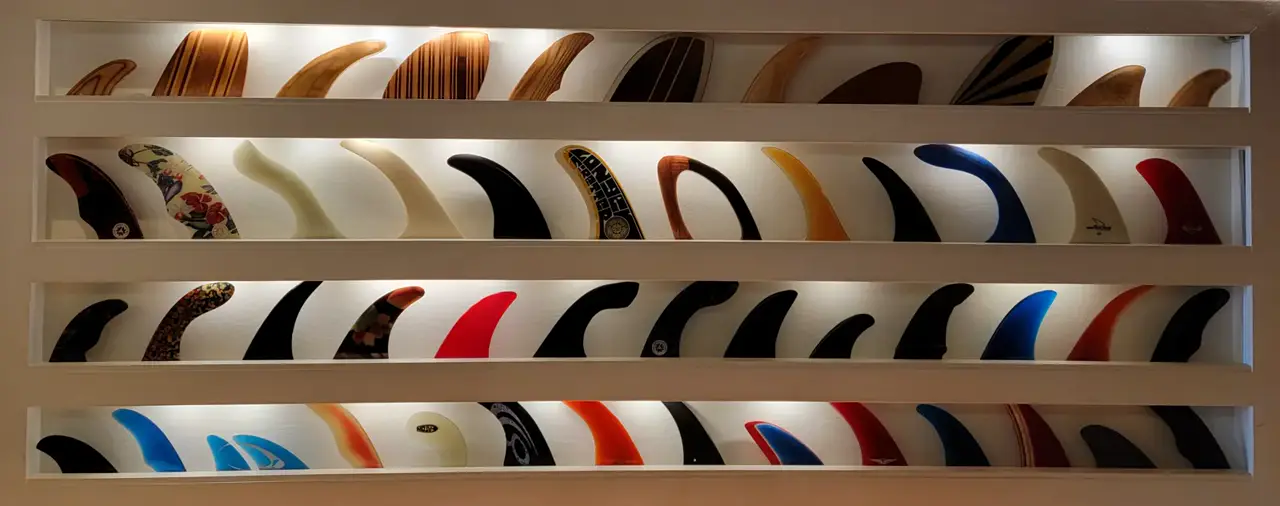
Your fin setup significantly impacts your board's feel in tropical waves. For powerful reef break surfboards, stiffer fins with more rake (sweep) often provide better hold and drive. Carbon-fiber or composite fins are popular for their responsiveness.
- Thruster (3-fin): The most versatile setup, offering a balance of drive, control, and maneuverability. Great for all-around performance.
- Quad (4-fin): Offers more speed and drive, especially good for hollow waves and down-the-line surfing. Can feel looser than a thruster.
- 5-fin setup: Provides the option to switch between thruster and quad, adapting to various conditions.
Consider carrying a few different fin sets in your tropical quiver to fine-tune your boards to specific conditions. Browse our Fin Systems Guide for a deeper dive into fin selection.
Maintaining Your Tropical Destination Surfboards
The tropical environment, while beautiful, can be harsh on your gear. High UV exposure, heat, humidity, and constant saltwater immersion demand diligent care for your warm water surfboards.
UV Damage and Heat Exposure
The sun's intense UV rays can delaminate your board's fiberglass, cause yellowing, and significantly shorten its lifespan. Always store your boards in the shade, ideally in a reflective board bag, especially when traveling or between sessions. Never leave your board baking in a hot car or directly in the sun without protection. Heat can also cause excess pressure inside the board, leading to delamination or even blow-outs if not properly vented.
Dings and Reef Encounters
Colliding with reef is almost an rite of passage in tropical surfing. Minor dings are inevitable. Carry a small ding repair kit (solarez or similar) for quick fixes. Saltwater intrusion can destroy foam, so patch dings immediately. For more substantial damage, visit a local repair shop or consult our Repair Center for tips on temporary fixes.
Wax and Traction
Always use tropical temperature wax. Using cold water wax in warm water will result in a slippery mess. Apply fresh wax regularly to maintain good traction on your surfboards for tropical waves.
Region-Specific Recommendations: Tailoring Your Tropical Quiver
Different tropical destinations, while sharing similarities, often have unique wave characteristics that can influence your ideal tropical quiver selection.
Indoneisa (Mentawais, Bali)
Known for perfect, powerful, mechanical reef barrels. Your tropical destination surfboards here should lean towards performance shortboards and step-ups. A reliable 5'10" - 6'2" shortboard and a 6'4" - 6'8" step-up would be a solid foundation. Consider durable construction for inevitable reef encounters. Stab Magazine frequently features discussions on optimal boards for these iconic regions (www.stabmag.com).
Hawaii (North Shore Oahu, Maui)
The proving ground for big wave surfing and powerful reef breaks. For general surfing on the North Shore, a diverse warm water surfboards quiver is essential. Performance shortboards are key for places like Sunset and Haleiwa, with step-ups and even proper guns for giant days at Waimea or Jaws if you're up for it. For smaller, playful days, a fish or hybrid can be fun.
Caribbean (Barbados, Puerto Rico)
Offers a mix of powerful reef and point breaks, often punctuated by hurricane swells. A versatile high-performance shortboard and a reliable step-up for hurricane swells are good choices. A funboard or fish will handle the smaller, mellower days. The conditions here make a range of surfboards for tropical waves particularly useful.
Pro Tip: Many surf camps or resorts in tropical destinations offer board rentals. While it can be more convenient, nothing beats the familiarity and performance of your own perfectly tuned tropical quiver.
Conclusion: Mastering the Tropical Wave with the Right Board
Choosing the right surfboards for tropical waves is about matching your equipment to the unique power, shape, and unforgiving nature of these incredible breaks. From the precise performance of a shortboard in a spitting barrel to the cruising glide of a funboard on a mellow reef, a well-thought-out tropical quiver ensures you're ready for anything. By considering volume, rocker, rail design, fin setup, and durability, you'll be well-equipped to make the most of every warm water session. Don't leave your tropical surf trip to chance—invest in the right tropical destination surfboards and unleash your full potential in paradise.
If you're still unsure about your perfect board, our the board finder can provide personalized recommendations based on your specific travel plans and surfing goals. For beginners embarking on their first tropical surf adventure, remember to check out our Learn to Surf guide before hitting the reef!
Frequently Asked Questions (FAQ)
Q1: What type of surfboard is best for small tropical waves?
For small, weak tropical waves, a fish or a performance groveler board is ideal. These boards typically have a flatter rocker, wider outline, and may feature twin or quad fin setups to maximize speed and glide from minimal swell, making them excellent warm water surfboards for less powerful days.
Q2: How many boards do I need for a tropical surf trip?
For a comprehensive tropical surf trip, a tropical quiver of 2-3 boards is often recommended: a high-performance shortboard for everyday waves, a step-up for larger swells, and an optional fish or funboard for smaller, playful conditions. This covers most scenarios you'll encounter with surfboards for tropical waves.
Q3: What fin setup is best for powerful reef breaks?
For powerful reef break surfboards, a thruster (3-fin) setup offers a balanced combination of drive, hold, and maneuverability. A quad (4-fin) can provide more speed and release, especially in hollow waves. Many surfers choose a 5-fin setup for the versatility to switch between these options.
Q4: How do I protect my surfboard from tropical heat and sun?
Protect your tropical destination surfboards from tropical heat and UV by always storing them in a reflective board bag, keeping them in the shade, and never leaving them in a hot car. Overheating can cause delamination. Use tropical temperature wax for optimal grip. Ensuring proper care extends the life of your warm water surfboards.
Q5: Should I bring my own boards or rent in the tropics?
While renting boards can be convenient, bringing your own surfboards for tropical waves is generally recommended. You'll be more familiar with your own equipment, which translates to better performance and confidence in challenging conditions. Your personal tropical quiver will be perfectly tuned to your style and preferences.