Winter Surfboard Setup: Cold Water Quiver Guide
A dialed winter surfboard setup is the difference between surviving cold water beatings and scoring the waves of your life. Learn how cold water surfboard volume, tailored rail profiles, fin templates, and dedicated step-up boards transform your cold water sessions.
Surfboard Life · November 6, 2026 · 13 min read
A high-performance winter surfboard setup requires adding 1.5 to 3 liters of volume, extending rail length by 2 to 6 inches, and selecting stiffer, raked fins to counter heavier water density and the physical drag of thick neoprene suits in powerful, organized winter swells.
When cold fronts push heavy maritime swells onto continental shelves, the ocean transforms. Water temperatures plummet below 50°F (10°C), offshore winds howl, and standard everyday shortboards suddenly feel sluggish, loose, and under-gunned. Winter brings the best waves of the year across the globe, from the thumping beach breaks of Northern California and France to the frigid points of the Pacific Northwest and the North Atlantic. Yet, paddling out with your everyday summer stick inevitably leads to missed takeoffs, delayed drops, and blown sections.
Mastering winter waves demands an intentional approach to equipment. In this comprehensive guide, we unpack the mechanical science behind cold water surfboard volume, examine construction dynamics in freezing seas, dissect our complete step-up surfboard guide, and provide actionable blueprints to build the definitive winter quiver setup.
Dialing Your Winter Surfboard Setup: The Neoprene Factor
Optimizing your winter surfboard setup begins with acknowledging the physiological and environmental tax imposed by cold water. When you plunge into cold seas, two primary factors diminish paddle velocity and board response: human payload weight and water density.
Cold Water Performance Tax = (Wetsuit Payload [5-12 lbs]) + (Increased Water Density [+1.5%]) + (Muscular Viscosity)
The True Weight of Cold Water Armor
A high-performance 4/3mm or 5/4mm hooded steamer, coupled with boots and gloves, absorbs water and adds between 6 to 12 pounds of static weight to your frame. Furthermore, thick neoprene constricts your shoulder girdle, reducing paddling cadence by an estimated 10% to 15%. If your summer body weight is 175 lbs (79 kg) riding a 30-liter high-performance shortboard, your functional winter weight surges toward 185–187 lbs.
Fluid Mechanics and Buoyancy Shifts
According to maritime hydrodynamic studies referenced by Surfline, ocean water increases in physical density as temperatures drop toward 39°F (4°C). Denser water provides fractionally more hydrodynamic lift, but this lift is substantially overshadowed by increased surface drag and fluid viscosity. The surface tension of freezing water clings to your rails, necessitating extra drive and surface area to glide efficiently.
To calculate your exact baseline before applying winter multipliers, use our interactive Volume Calculator to establish your target floatation metrics.
Pro Tip: As a standard rule of thumb for winter surfboard sizing, add 1.5 to 2.5 liters to your everyday shortboard volume for standard winter waves, and add 3 to 6+ liters when stepping up into serious, heavy-water conditions.
Winter Surfboard Sizing and Volume Distribution
Simply blowing up the dimensions of your standard shortboard produces a corky, unresponsive craft that will skip out on steep, wind-whipped drops. Effective winter surfboard sizing centers on where that foam is distributed rather than simply blowing out rail thickness.
Forward Volume Bias for Cold Water
To counteract the paddle handicap of heavy neoprene, modern winter boards utilize a forward-biased foil. Foam is packed underneath the chest and extended slightly into the nose outline, maintaining early entry capabilities. This allows you to match the speed of fast-moving winter swells without needing an excessively wide nose that catches howling offshore chop.
Tapered Foils and Sensitive Tails
While the center and chest zones hold the volume, the tail block must stay refined. A thick, boxy tail will resist penetration when dropping into a dredging, offshore-groomed ledge. Experienced shapers pull the volume down rapidly past the back foot, creating a foiled, sensitive tail profile that bites directly into the face of the wave. Check our in-depth breakdown of Surfboard Anatomy to understand how foil transitions influence drive and release.
The Step-Up Surfboard Guide: Taming Serious Winter Swells
When swell periods push past 15 seconds and face heights double overhead, standard shortboards run out of operational runway. This is where a dedicated step-up becomes non-negotiable. Our step-up surfboard guide clarifies the architectural nuances required for tackling overhead conditions.
Length, Rocker, and Outline Adjustments
A true step-up board typically measures 2 to 6 inches longer than your standard daily driver. This added waterline delivers essential paddle speed to scratch through heavy offshore wind and position early on outside peaks.
- Entry Rocker: Increased continuous smooth rocker through the nose prevents pearling during late, steep drops.
- Tail Rocker: Moderated through the center for down-the-line speed, with a subtle acceleration off the tail to allow directional changes inside critical sections.
- Outline: The wide point is drawn 1 to 2 inches forward of center, narrowing down to a streamlined rear profile.
Selecting the Right Tail Shape
Tail design defines how water releases from your board at high speeds. Winter surfing prioritizes control, hold, and rail engagement over loose, tail-sliding release:
- Round Tail: The undisputed king for all-around winter performance. It delivers continuous flow from rail to rail, providing predictable hold in steep faces and smooth transitions in choppy conditions.
- Round Pin: The benchmark for high-velocity step-ups and hollow reef or point waves. Pins anchor the tail deeply into the water column, eliminating cavitation and tail bounce when engaging down-the-line trim at 25+ mph.
- Swallow Tail: Excellent for cold water beach breaks that feature power but require quick, radical snaps inside tight pockets. Keep the swallow narrow to avoid overpowering the fins.
To explore the entire spectrum of tail, nose, and outline architectures, visit our comprehensive Board Types Guide.
Pro Tip: Never test a brand-new step-up in maxing, high-consequence conditions. Take it out in clean, overhead surf first to calibrate your back-foot sweet spot and understand how the increased rail line responds through bottom turns.
Board Construction for Cold Water: PU vs. Epoxy
Cold water alters the material performance of your board. The physical response of composite resins, foam blanks, and stringers shifts noticeably under freezing conditions, a topic frequently analyzed by material testers at Stab Magazine.
+-------------------------------------------------------------------------+
| Polyurethane (PU) / Poly:                                               |
| - Superior dampening in choppy, cold water                              |
| - Natural flex pattern stays active below 45°F (7°C)                    |
| - Added natural weight punches cleanly through offshore chatter         |
+-------------------------------------------------------------------------+
| EPS / Epoxy:                                                            |
| - Ultra-buoyant and responsive, but can feel chattery in heavy seas     |
| - Stiffens up dramatically in sub-50°F water                            |
| - Prone to deflection on wind-blown, chunky wave faces                  |
+-------------------------------------------------------------------------+
Why Polyurethane (PU/PE) Remains the Winter Standard
For decades, traditional polyurethane blanks wrapped in fiberglass and polyester resin have remained the gold standard for heavy, cold conditions. PU provides innate vibration dampening. Winter swells are rarely glass-smooth; they feature currents, chop, and strong offshore texture. The organic density and flex profile of PU absorb this kinetic chatter, allowing the rail to maintain uninterrupted contact with the wave face.
The Role of Epoxy and High-Tech Composites
While expanded polystyrene (EPS) epoxy constructions yield energetic bounce in warm, small waves, they can feel overly skittish and flighty in cold water. Cold temperatures increase the modulus stiffness of epoxy resins, compounding board vibration. However, custom EPS stringered boards glassed with heavier 6oz cloth configurations—or specialized carbon-infused rail laminates—can work exceptionally well for surfers prioritizing rapid acceleration on smooth, freezing point breaks.
If you do encounter cracks or compressions after enduring heavy winter washings, consult our detailed Repair Center to preserve your board's structural integrity.
Dialing Your Fin Setup: Hold, Cant, and Rake
Fins function as the functional wings of your board beneath the water line. When wave faces stretch and water thickens, the loose, upright fins you favor for summer slays will cause fatal side-slips on critical takeoffs.
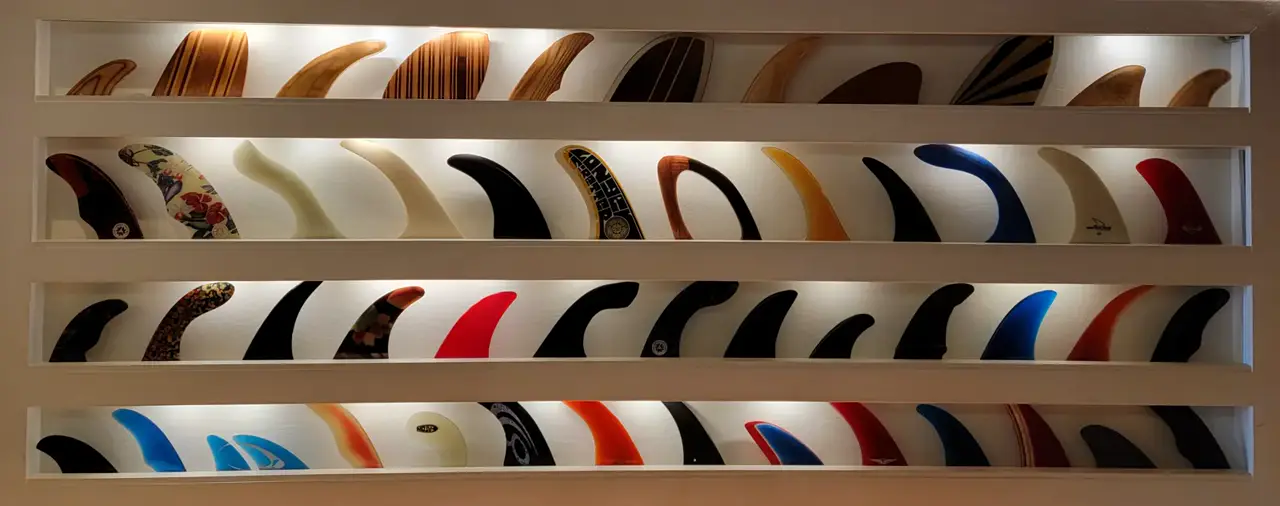
Fin Templates: Upright vs. Raked
- Raked Fins (High Sweep): Essential for winter surf. A drawn-back rake angle provides profound projection, down-the-line hold, and security through wide, arc-carving bottom turns. Seek templates with medium-to-large surface areas to balance your body’s increased winter weight.
- Upright/Pivot Fins: Avoid these in heavy winter conditions unless surfing small, hollow shorebreak. They release too quickly and lack the directional hold required on large wave faces.
Material Flex: Solid Fiberglass vs. Soft Cores
Soft, flexible plastic or honeycomb fins bend excessively under the violent hydrodynamic loads generated by double-overhead winter waves. Step up to solid fiberglass or carbon-base stiffened fins. Stiff fins translate your foot pressure directly into drive without speed-sapping cavitation.
Thruster vs. Quad Configurations
- Thruster (3 Fins): Offers supreme directional control and pivot from the pocket. It allows you to scrub speed easily on steep drops and draw predictable vertical lines.
- Quad (4 Fins): The ultimate weapon for pure speed, hollow tubes, and high-line security. Quads generate instant forward velocity out of the gate and hold an edge higher on steep, barreling wave faces because the twin rail fins mirror the water's upward curve without the drag of a central trailer.
Check our dedicated Fin Systems Guide to compare leading box configurations, cant measurements, and foil types.
Pro Tip: If your step-up features a 5-fin convertible box, switch from your summer thruster to a quad configuration with smaller rear trailers (like 50/50 foiled 4.0-inch quad rears) for hollow, barreling winter conditions.
Building the Ultimate Winter Quiver Setup
A versatile winter quiver setup eliminates the guesswork on cold, blustery mornings when conditions shift rapidly with tidal swings and surging swell periods. Here is the ideal 3-board quiver for navigating cold water waves through the colder months:
                    THE COMPLETE WINTER QUIVER

 [ Daily Winter Driver ] ----> [ The True Step-Up ] ----> [ The Heavy Sledge ]
  0 to +2" over height         +2" to +5" over height     +6" to +10" over height
  Base Vol + 1.5 - 2.5L        Base Vol + 3.0 - 5.0L      Base Vol + 6.0 - 10.0L
  Round or Squash Tail         Round Tail                 Pin or Round Pin
  Everyday 4-8ft Surf          Dumping 8-12ft Reefs/Beach 12-18ft+ Outer Bomboras
1. The Daily Winter Driver (The Foundation)
- Sizing: Standard height or +1 inch; width up by 1/8"; volume boosted by 1.5 to 2.5 liters over your summer shortboard.
- Characteristics: Continuous, moderate rocker, medium-low rails, round tail or heavy squash tail.
- Deployment: Your primary craft for 70% of winter sessions—punchy beach breaks, head-high points, and everyday winter groundswells.
2. The Solid Step-Up (The Workhorse)
- Sizing: 3 to 5 inches longer than your daily driver; thickness slightly increased; volume up by 3 to 5 liters.
- Characteristics: Foiled round-pin or narrow round tail; clean single-to-double concave; stiff glass-on or carbon-matrix fin setup.
- Deployment: Overhead to double-overhead hollow reefs, dredging beach breaks, and long-period point waves sweeping with heavy current.
3. The Cold Water Sledge (The Gun / Semi-Gun)
- Sizing: 6 to 10+ inches longer than your everyday board; narrow 18.5"–19.25" width; volume up by 6 to 10+ liters.
- Characteristics: Needle-sharp pin tail, heavy-duty glassing (double 6oz deck, 6oz bottom), heavy entry rocker, maximum forward volume.
- Deployment: True heavy-water arenas, outer reefs, deep-water bombies, and maxing winter swells documented across competitive circuits like the World Surf League.
If you are uncertain where your progression sits, try our automated Board Finder Quiz or consult our the board finder for immediate, hyper-personalized equipment guidance.
Winter Surfboard Sizing Matrix: Weight, Skill, and Volume
Use this detailed reference matrix to cross-examine your standard volume requirements against our verified cold water surfboard volume equations based on surfer weight and ability.
| Surfer Weight | Intermediate (Summer Vol) | Intermediate (Winter Driver) | Intermediate (Winter Step-Up) | Advanced (Summer Vol) | Advanced (Winter Driver) | Advanced (Winter Step-Up) | | :--- | :--- | :--- | :--- | :--- | :--- | :--- | | 140–155 lbs (63–70 kg) | 26.0–28.0 L | 28.0–30.0 L | 31.0–33.5 L | 24.0–25.5 L | 25.5–27.0 L | 28.0–30.0 L | | 155–170 lbs (70–77 kg) | 28.5–31.0 L | 30.5–33.0 L | 34.0–36.5 L | 26.0–27.5 L | 27.5–29.5 L | 30.5–32.5 L | | 170–185 lbs (77–84 kg) | 31.5–34.0 L | 33.5–36.0 L | 37.5–40.0 L | 28.0–30.0 L | 30.0–32.0 L | 33.0–35.5 L | | 185–200 lbs (84–91 kg) | 34.5–37.5 L | 37.0–40.0 L | 41.0–44.0 L | 30.5–33.0 L | 33.0–35.0 L | 36.0–39.0 L | | 200+ lbs (91+ kg) | 38.0–42.0+ L | 41.0–45.0+ L | 45.5–49.0+ L | 34.0–37.0+ L | 36.5–40.0+ L | 40.0–44.0+ L |
Note: Beginners navigating cold waves should bypass fine-tuned shortboard sizing altogether and review our foundational Learn to Surf guidelines, targeting funshapes and longboards carrying 50–70+ liters for safety and paddle mechanics.
Spot Variations: Regional Demands on Winter Equipment
Different coastlines demand unique adaptations to your winter surfboard setup. Tailoring your quiver to your local break's bathymetry is critical.
                                REGIONAL DEMANDS

    NORTHERN CALIFORNIA / PACIFIC NW        PORTUGAL / EUROPEAN ATLANTIC
  - Intense current & shifting peaks      - Massive, heavy beach break barrels
  - Requirement: Forward volume, PU       - Requirement: Heavy-duty 6oz glassing,
    density, long rail lines (Step-up)      stiff quads, narrow pin-tails
Northern California & The Pacific Northwest
Characterized by deep-water oceanic trenches, fast rip currents, and massive swell energy. Surfers here face constant paddling battles. The ideal setup leans toward heavier glass jobs, pulled-down rounded pins, and extra paddle-length (adding 4 to 6 inches over standard sizing) to deal with shifting ocean peaks.
The European Atlantic (France, Portugal, Ireland)
Sandbanks at beach breaks like Hossegor and Nazaré compress raw North Atlantic swells into explosive, square barrels. The emphasis here is on instantaneous takeoffs and sheer durability. Stronger stringers, specialized composite layers, and aggressive tail rockers keep your nose from catching when dropping directly down the face of a below-sea-level wedge.
Winter Wax, Leashes, and Cold Maintenance
Dialing in your board goes beyond shape and fins; deck accessories and maintenance complete your winter readiness.
- Cold and Ice-Cold Wax Formulations: Running warm water wax in sub-55°F seas renders your deck as slick as an ice rink. Completely strip your board down to the clean fiberglass and lay down an aggressive cross-hatch basecoat, topped with ultra-soft cold wax (rated for water below 58°F/14°C).
- Heavy-Duty Winter Leashes: Summer competition leashes (5mm) will snap under the weight of winter waves. Step up to an 8mm to 9mm heavy-duty or big wave leash. Always verify that the leash length matches or slightly exceeds the length of your board to prevent rebound impacts.
- Inspect Fin Boxes and Stringers: Heavy winter loads test the structural integrity of your board. Check your fin boxes for micro-fractures and stress rings after heavy wipeouts. Read through our Surfing History archives to see how early pioneers transitioned from leashless wooden planks to reinforced modern cold water artillery.
Pro Tip: Never leave your surfboard inside a freezing vehicle overnight before a cold morning session. Sub-zero air can make blanks brittle and cause microscopic condensation beneath the glass, which may lead to delamination when exposed to the sun later.
Final Takeaways for Your Winter Arsenal
Winter surfing separates the casual enthusiast from the truly committed ocean athlete. By dialing in your winter surfboard setup with deliberate adjustments to foam volume, outline length, rail foils, and structural materials, you eliminate equipment failure from the equation. When the horizon darkens with incoming corduroy lines and the spray blows high off the back, you will sit with unwavering confidence, fully equipped to stroke into the ride of your season.
Frequently Asked Questions
How much volume should I add to my winter surfboard setup?
Most surfers should add 1.5 to 3 liters of volume to their daily winter boards and 3 to 6+ liters to their dedicated step-up boards. This extra volume compensates for 6 to 12 pounds of waterlogged neoprene gear, paddling fatigue, and the drag generated by dense, freezing seawater.
Can I use EPS/Epoxy boards in cold winter waves?
Yes, but with caveats. EPS boards are lighter and naturally more buoyant, which can cause them to chatter and deflect across choppy, wind-blown winter wave faces. If you ride epoxy in winter, choose models constructed with heavier 6oz glassing schedules or dampening stringers to ensure the board remains planted inside bumpy wave troughs.
What tail shape is best for a winter step-up surfboard?
The round tail and round pin are the premier choices for winter step-ups. These tails maximize continuous water flow without early release, giving you control, stability, and hold through high-velocity bottom turns and critical drops.
What fins work best for powerful winter surf?
Choose stiff, highly-raked fins crafted from solid fiberglass or carbon-reinforced composites. Raked fins provide essential drive and hold on steep drops, whereas upright, flexy fins are prone to slipping, cavitating, and sliding out when exposed to intense swell energy.
Do I need a different leash for my winter setup?
Yes. Swap out your thin 5mm or 6mm summer leashes for an 8mm to 9mm heavy-water leash. Winter waves carry exponentially more kinetic mass, and thicker rubber prevents leash breakage, keeping your board attached when taking sets on the head.